
Gerald Pirner ► In Memory of Jess Curtis: Describing Into the Dark
Gerald Pirner
Into an absolute darkness. Seeing nothing, one is led in to the theater on the arms of performers, as there would be no other way to enter. The lights are out, first one hears only sounds and it is unclear where they are coming from.
A smack. Something rolling over a dance floor whose movement gives a sense of the room. First one performer, a second, then more—a whole company gathers.
Movement in duets emerge where one dancer describes to the other what is happening, what he or she is doing to and with the other.
Smaller and grander choreographies develop where the dancers find themselves breathing together and singing in a chorus and losing themselves in the dance in the space between their prescribed moves. All of this constructing and deconstruction is happening in a space that is completely dark. It is a mass of dark, unknown beings in which those present can only feel that others are nearby.
Then a tableau vivant is created, dancers scatter and reunite, discovered by a blind performer as a large-scale living sculpture. As if in an attempt to capture magic, the blind man pulls out a flashlight in order to illuminate one dancer, and then the next, in a picture he bestows on everyone without seeing it himself. As he feels for each performer, he casts light upon each one, such that touch becomes light.
From this sculpture made by the others, which harbors tragedy at the heart of it, a pair of Black non-binary performers simulate a Pietá. The sound of a cheerful laugh is heard, transforming into weeping, like some evil character from the movie Gremlins. The woman's sobs are answered by a performer singing, as if on the edge of death: Darkness is, where we dream, darkness is, where we will be free.
This is one of the last sentences of his last performance. Jess Curtis is dead.
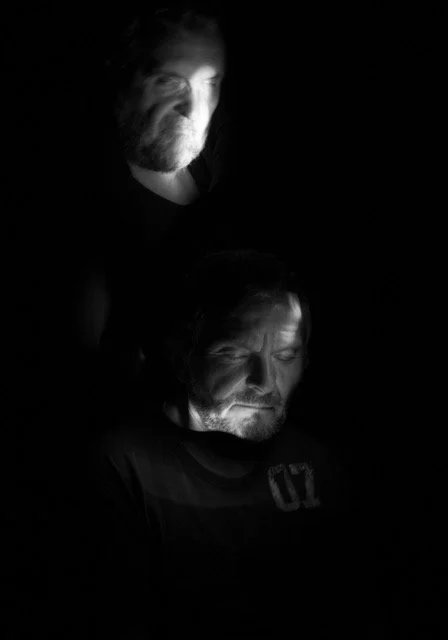
Jess Curtis with open eyes
In Gerald Pirner's photographs his models always have their eyes closed. Jess Curtis defied this convention, and kept his eyes open in his portrait, which of course the blind photographer did not notice. This is the last photo that Gerald Pirner took of his teacher and friend Jess Curtis.
– Gerald Pirner, May 2024
Gerald Pirner
Gerald Pirner – after studying theatre and philosophy – works as an art critic, editor for the Kreuzberg publishing house Schwarze Risse and wrote articles on factory work and social struggles for various magazines. After going blind in 1989 due to retinitis pigmentosa, he trained as a media documentarian at the Sächsische Zeitung in Dresden in 1992 and subsequently began writing as an essayist for the online magazine kultura-extra in 2006. In 2014, he founded "Gerald Pirner - Texte zu Kunst", a website on which he publishes essays on visual arts, theatre, music and film from the perspective of a blind person. Since 2019 he has been working with Gravity Access Services as a consultant and co-author of audio descriptions. He also works on various dance performances and installations in audio description for Sophiensäle. In 2015, he began to work with photography and in 2017 founded the Fotostudio für Blinde Fotograf*innen (Photo Studio for Blind Photographers) in Berlin with the photographer Karsten Hein, among others. He works primarily in the technique of light painting. His photographic works have been shown in various exhibitions, most recently in June 2021 in the forum edition of f/stop, the festival for photography in Leipzig. www.geraldpirner.com
